Casting Sides vs Full Script: A Security Guide
Decide when actors, agents and casting teams need role-specific sides versus the complete screenplay, with practical access and privacy controls.
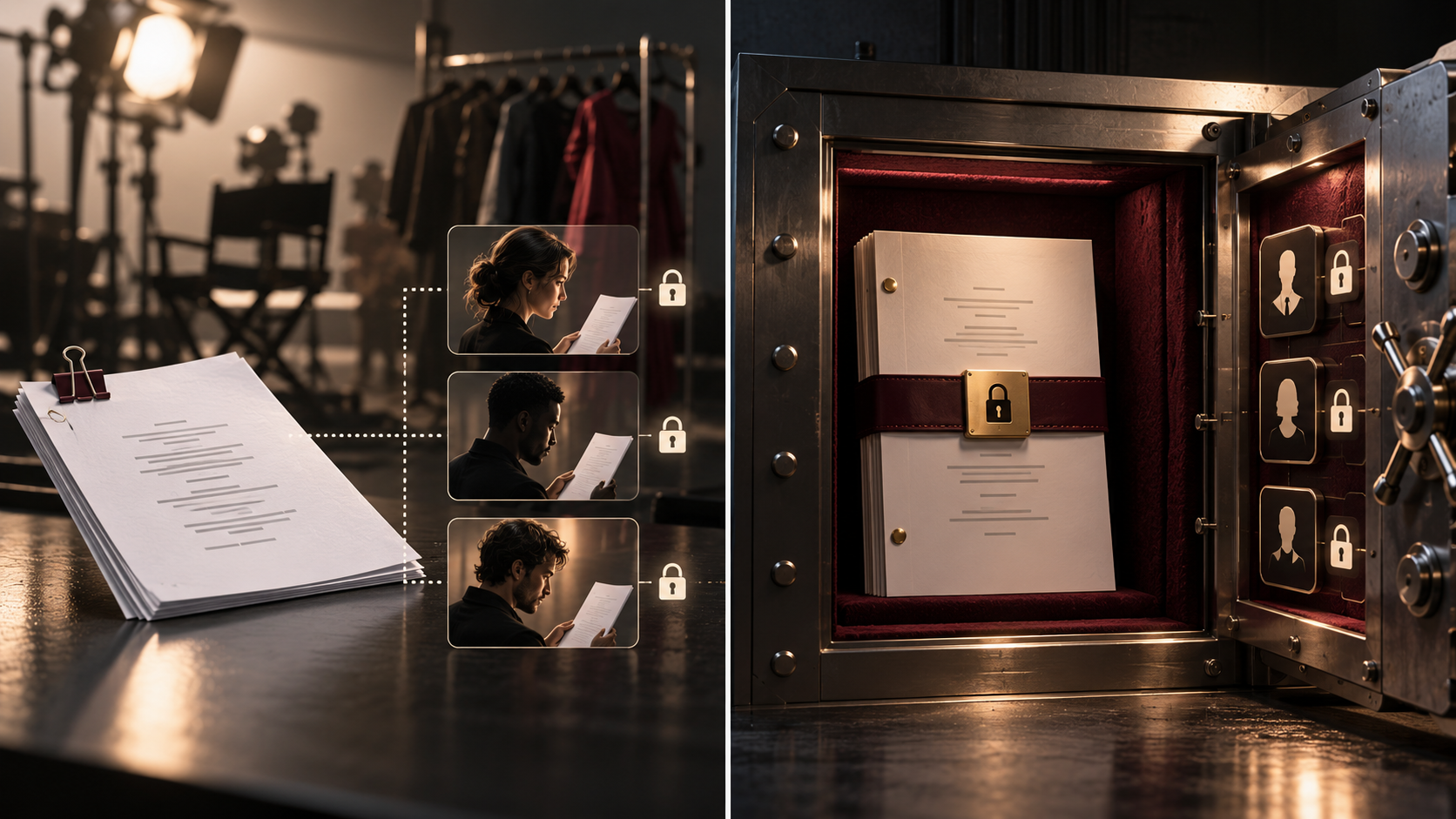
Casting sides are selected script pages used for auditions or role-focused review. A full script contains the complete screenplay or episode. From a security and privacy perspective, sides are usually the better default for early casting because they minimize disclosure while giving performers the material needed to prepare. A full script becomes appropriate when broader context is necessary or the actor is seriously attached to the project.
The choice is not purely about secrecy. Actors need enough information to understand the role, consent to sensitive material and make professional decisions. The correct scope balances creative context, performer rights and production confidentiality.
The short answer
Use sides for initial auditions, day players, background roles and limited vendor needs. Use the full script for principal cast, late-stage negotiations, read-throughs and active production roles when the complete narrative is necessary. Apply recipient-specific access, clear version labels, reasonable expiry and a readable watermark in both cases.
What casting sides should include
Sides should contain the scenes required for the audition, enough preceding context to understand the moment and practical instructions. Depending on the role, include character name, scene partners, tone, language, physical action and relevant content notices through the proper casting channel.

Figure 1: Casting sides disclose only what a performer needs, while the full screenplay remains protected.
The process map below shows how to isolate open audition sides from confidential full-length production drafts:
Do not extract pages carelessly. A page may begin in the middle of a scene or refer to information on a prior page. Add a short approved context note rather than releasing unrelated sections.
Use the project's approved working title if the public title is confidential. Remove internal notes, casting deliberations, personal contact information and comments. Preserve scene and page references so the team can compare performances and later map back to the current script.
When the full script is justified
Principal actors may need the full arc to assess character development, themes, sensitive content and scheduling implications. Agents and lawyers may need to understand the role before negotiating. Directors and attached cast need a common text for creative preparation.
The full script may also be appropriate for a final callback, chemistry read or table read. Expand access deliberately rather than allowing an initial sides link to reveal the full file.
Record who approved full-script access and which draft was provided. If the script contains highly sensitive twists or cameos, consider whether selected recipients need a more restricted group.
The risk difference
The impact of an exposed side is often narrower than the impact of an exposed complete screenplay. Sides may still reveal casting, dialogue, plot and project identity, so they are not risk-free.
A full-script leak can expose the entire story, unreleased characters, commercial strategy and creative changes. It may also include information subject to contracts with writers, talent, financiers or underlying-rights holders.
Security effort should scale with scope. Full scripts may justify stronger identity, recipient-specific watermarking, download restrictions and shorter review windows for early candidates.
Access model for sides
Use a unique actor or agent link where practical. Verify the email through the casting platform or production office. Set expiry after the audition deadline and a short grace period. Permit download or print if the self-tape process requires it, ideally with a recipient or candidate code watermark.
The matrix below outlines the critical distinctions in exposure risk, watermarking requirements, and access controls:
Avoid one open URL for all candidates. It can be reposted and makes revocation or version updates difficult. If the platform distributes sides within an authenticated role workflow, use that process instead of duplicating links.
Keep self-tape uploads separate from script distribution so one candidate cannot see another's submission.
Access model for full scripts
Require named recipients or an approved agency group. Use separate links for the actor and representative if attribution matters. Apply a recipient-specific mark, define download and print rights and state the review period.
For attached cast, move the recipient into the production script system rather than leaving a temporary casting link open. Production access may include revision alerts, offline copies and longer duration. Remove access when the engagement ends according to contracts and production policy.
Test whether the recipient can see other users, group names or unrelated documents. A full-script room should not expose the cast list by accident.
Watermark design by document type
Sides can use a project code, role, candidate ID and release date. Avoid placing the performer's private email prominently when sides may be handled by a coach or reader. A full script may use name, organization and unique copy ID.
Keep marks light and readable. Audition material must support performance. Test mobile view, print and screen readers. A mark that covers dialogue may cause the performer to request an unprotected copy.
Dynamic viewer marks can simplify administration, but downloaded files must also be tested. Some systems protect only online rendering.
NDA decisions
High-profile or confidential projects may use an NDA before releasing sides or a full script. Others use casting-platform terms, submission releases or confidentiality clauses in later agreements.
Use a counsel-approved process. A minor performer may require a parent or guardian workflow. An actor working through a loan-out company or agent may raise questions about the signing party.
Do not assume an NDA justifies excessive data collection or full-script distribution. Minimum scope remains useful after signing.
Accessibility and performer fairness
Security settings should not disadvantage a performer who uses assistive technology, needs a printable copy or has limited connectivity. Provide an accessible controlled alternative. Do not require unsupported software without notice.
State deadlines and time zones clearly. If a link fails, provide a support route that does not expose the performer to the creative decision makers unnecessarily. Access problems should not be interpreted as lack of preparation.
Content notices and consent-related information should not be withheld merely to protect plot secrecy. Coordinate with casting and production professionals to give performers what they need to make informed choices.
Version management
Sides must map to the current audition round. If dialogue changes, issue a clearly labeled new version and state whether candidates should re-record. Do not replace a PDF silently after performers have prepared.
For full scripts, use the production's revision convention. Record release date, page count and revision label. When an actor moves from casting to production, close the old link and provide the approved production draft.
Keep a distribution log containing recipient, role, document scope, version, access settings, date sent, expiry and closure.
Decision matrix
| Scenario | Sides | Full script | Reason |
|---|---|---|---|
| First-round audition | Preferred | Rare | Minimum disclosure supports the task |
| Callback | Usually | Sometimes | More context may be needed |
| Chemistry read | Selected expanded scenes | Sometimes | Relationship and arc may matter |
| Offer or serious negotiation | Supporting | Often | Actor and representatives assess the role |
| Attached principal cast | Useful for specific work | Yes | Ongoing creative and production context |
| Day player | Usually | Rare | Limited role and duration |
| Acting coach or reader | Same approved sides | Only with authorization | No automatic right to the full project |
Preparing secure sides step by step
- Confirm the current authoritative screenplay.
- Select scenes approved by casting and production.
- Add necessary context and content notices.
- Remove unrelated pages, comments and metadata.
- Apply project, role and candidate identifiers.
- Configure verified access and expiry.
- Allow the functions needed for the audition.
- Test on common performer devices.
- Send through the approved casting channel.
- Expire the link and retain only the required record.
Platform selection
Casting platforms are often best when they already integrate roles, sides, NDAs, messaging and self-tapes. Production platforms are better once cast members need full drafts and revisions. Secure document tools can support focused exchanges outside those systems.
Teams may test SendNow's movie-script controls for verified links, watermarks, expiry and revocation. Confirm that the viewer supports auditions, accessibility and any required downloads. Do not move recipients from an official casting platform solely to collect more analytics.
Read sharing scripts with actors and agents, secure film production script sharing and screenplay NDA before sharing.
Privacy and retention
Casting combines creative content with personal data and self-tapes. Limit access to authorized casting and production staff. Set retention for unsuccessful candidates and remove temporary reviewers. Follow applicable union, employment, safeguarding and privacy requirements.
Avoid circulating candidate activity analytics. Whether someone opened sides at a certain time is usually operational information, not a creative evaluation metric.
If a project is cancelled or recast, revoke script access and handle performer data under the approved policy.
When even casting sides reveal a major spoiler
Some audition scenes reveal a character's survival, identity, relationship or involvement in a confidential sequence. Trimming the page may remove the disclosure but also remove the emotional logic an actor needs. Casting and production should decide deliberately rather than asking a coordinator to improvise.
Options include rewriting a temporary audition scene, replacing proper names with approved placeholders, limiting the material to late-stage candidates or presenting the scene through a controlled live read. A temporary scene should be labeled clearly so performers do not assume it is final dialogue. Do not mislead actors about sensitive content they may later be expected to perform.
Record which candidates received the spoiler-sensitive version. Use shorter expiry and named access, but avoid creating an intimidating process that implies wrongdoing before a performer has joined the project. The production's creative and safeguarding obligations remain more important than preserving a surprise for its own sake.
Frequently Asked Questions
What are casting sides?
Casting sides are selected script pages used for auditions, callbacks or role-focused review. They usually contain less story information than the full screenplay.
Should audition sides include the title of the film?
Use the approved public or working title. Highly confidential projects may use a code name, but performers still need clear instructions and a way to verify legitimacy.
When should an actor receive the full script?
When broader context is necessary for a serious creative, contractual or production decision, subject to the project's confidentiality process.
Can sides be downloaded?
They can when rehearsal, self-tape or accessibility needs justify it. Use a watermarked copy and defined expiry or destruction expectation where appropriate.
Should an agent get a separate link?
Separate links improve attribution and avoid credential sharing. An approved agency group may be practical when several authorized representatives are involved.
Do sides need an NDA?
It depends on project sensitivity and the casting process. Use approved terms and do not impose a generic NDA without reviewing the recipient and legal context.
Are casting sides protected by copyright?
They may contain protected screenplay expression, but the scope and enforcement of rights are legal questions. Obtain qualified advice for a specific dispute.
Sources and verification notes
- World Intellectual Property Organization: Copyright
- U.S. Copyright Office: Performing arts registration
- NIST Privacy Framework
- UK ICO: Data minimisation
Sources were reviewed on October 3, 2026. Adapt the workflow with casting professionals, unions and production counsel.