Startup Data Room Mistakes That Slow Fundraising
Avoid the data room mistakes that create investor confusion, permission risk, inconsistent metrics and unnecessary fundraising delays.
The most damaging startup data room mistakes are rarely cosmetic. They are failures of consistency, ownership and access: a cap table that conflicts with financing records, metrics without definitions, contracts missing amendments, sensitive files shared too early or a folder full of unexplained versions. These problems slow investor review and force founders to spend valuable fundraising time answering avoidable questions.
A data room does not need to be enormous to be credible. It needs to be current, coherent and appropriate for the stage of diligence. The goal is to help an authorized investor verify the fundraising narrative while protecting information that should be released only later or to a narrower group.
The short answer
Avoid uploading first and organizing later. Build a request-based index, select an authoritative file for every item, reconcile high-risk records, classify sensitivity, test external access and assign one owner for updates. A simple room with disciplined governance is more useful than a feature-rich room containing unreliable evidence.
Mistake 1: creating the room only after investors ask
Waiting until a serious investor sends a diligence list creates pressure to upload quickly. The team may pull documents from personal drives, email threads and outdated folders without resolving which version is correct. Questions then arrive while the room is still changing.

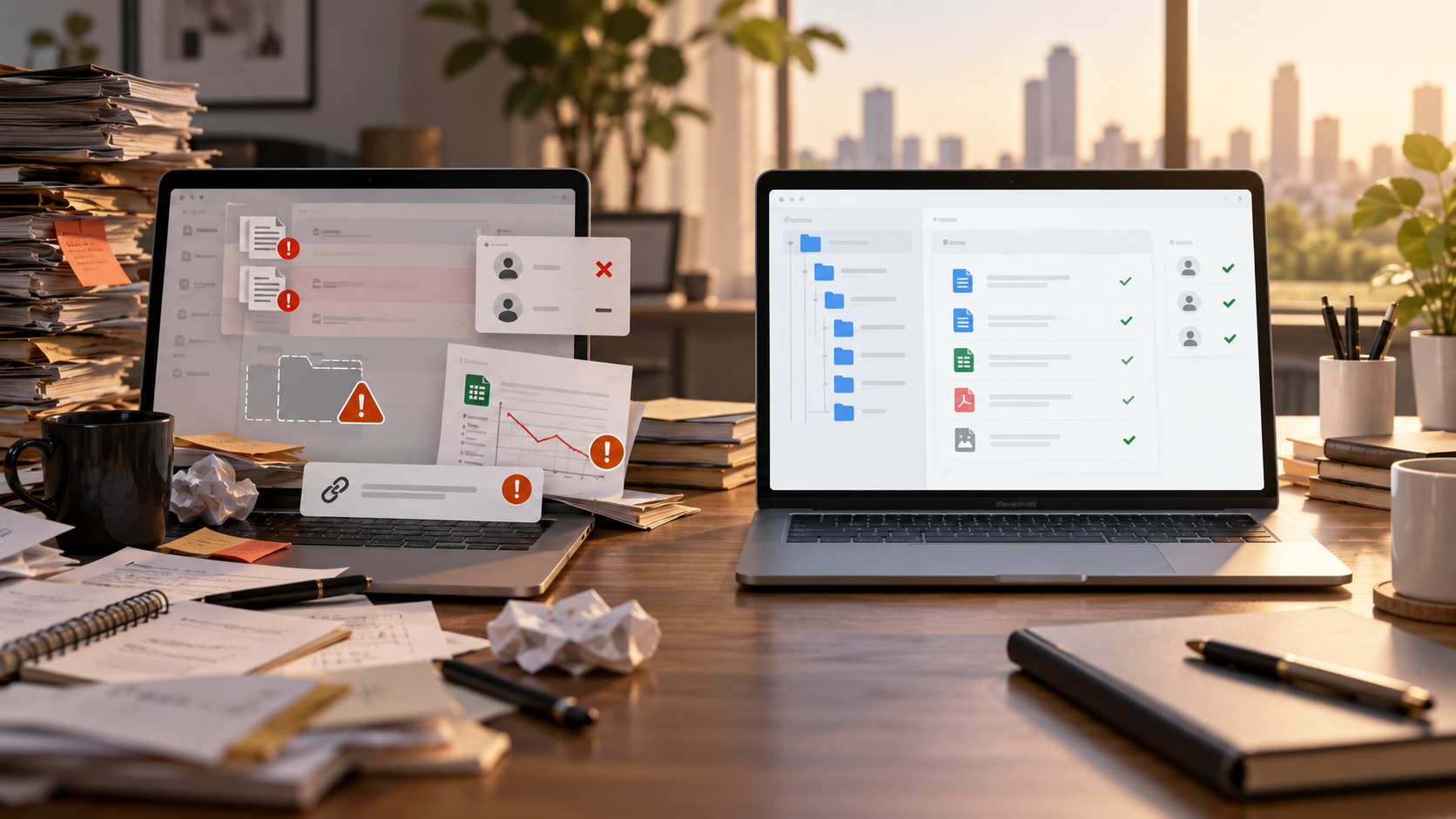
Figure 1: Consistent folders, controlled access, and clear ownership prevent common fundraising data-room mistakes.
The diagram below maps the most frequent operational errors that derail investor confidence during fundraising:
Prepare a core room before an active process. It does not need every document that a later-stage specialist may request. It should cover corporate records, capitalization, financing history, recent financial reporting, the operating plan, core metrics, material contracts, intellectual property ownership and key policies. Mark potential restricted materials for later stages.
Run an internal review before sharing. Founders, finance and counsel should agree on the authoritative set and the process for exceptions.
Mistake 2: treating the pitch deck as the source of truth
The deck is a concise narrative, not the accounting, legal or operating record. Problems arise when deck figures cannot be reconciled to the model, metric exports, contracts or cap table. Even small differences can create uncertainty if no one can explain them.
Create a claim map for important quantitative statements. Record the source, as-of date, owner, definition and calculation. Examples include revenue, annual recurring revenue, gross margin, active users, retention, customer count, burn and runway. The room does not need a separate memo for every number, but the team should know how to substantiate it.
When a number changes during fundraising, update the relevant files and note the period. Do not silently replace history with a new definition.
Mistake 3: uploading an unreconciled cap table
Cap tables are often maintained in spreadsheets or equity platforms, but investors may compare them with signed securities, board approvals, option records and previous financing documents. Common issues include omitted notes, inconsistent fully diluted assumptions, expired options, grants without approvals and legal names that do not match the records.
Reconcile the cap table with counsel and the underlying documents before publishing it. State the as-of date and define issued, outstanding and fully diluted figures. Identify assumptions about conversion, the unallocated pool and the proposed round.
Store prior financing documents in round-specific folders. Include amendments and side letters when they are material. A clean current cap table should not obscure the history needed to validate it.
Mistake 4: mixing drafts and executed documents
A folder containing "final," "final-v2" and "final-signed-new" asks the reviewer to solve an internal records problem. It also creates a risk that an unsigned or superseded agreement will be treated as operative.
Execute this pre-launch verification checklist before issuing data room access links to any prospective investor:
Use a deliberate execution-status convention. Keep internal drafts outside the disclosure room unless their review is specifically required. For executed agreements, include signature pages, schedules and amendments. If a document is pending execution, label its status clearly and identify the expected next step.
Version control is also important for financial models and policies. State the model date and scenario. Preserve a material prior disclosure if replacing it would otherwise erase what an investor reviewed.
Mistake 5: giving every recipient the same access
Equal access is simple to administer but often inappropriate. An investor evaluating a seed round may need a customer summary, while counsel later needs selected customer contracts. A technical specialist may need restricted architecture evidence, while another reviewer does not.
Create stages and groups. Initial access should contain the information appropriate to initial evaluation. Active diligence can add corporate, financial and commercial evidence. Restricted review can contain sensitive personal, customer, security or legal material for named people.
Test each group with a guest account. Review search results, filenames, notifications, shared links, download behavior and inherited permissions. Do not assume a folder label enforces confidentiality.
Mistake 6: publishing personal or confidential data unnecessarily
Startups sometimes upload personnel files, customer exports or identity documents because they were listed in an internal folder. This increases privacy and security risk without improving the investment decision.
Apply data minimization. Use headcount and compensation summaries when individual details are not required. Remove passwords, tokens, bank details, government identifiers and personal contact information. Redact customer information when a summary supports the current review stage.
Where detailed information is justified, limit it to the reviewers who need it, record the purpose and define when access ends. Coordinate with privacy and legal advisers.
Mistake 7: hiding known gaps
An empty folder with no explanation causes uncertainty. So does a request register that marks every line complete even when an item does not exist. Investors generally understand that young companies are still building processes. They are less comfortable when the room creates a false impression.
Use accurate statuses such as available, pending review, not applicable, not yet created and restricted. Add a concise explanation and owner where appropriate. Do not invent a policy or backdate an approval merely to fill a folder.
If the gap is material, explain the remediation plan and timing. Honest scoping is stronger than superficial completeness.
Mistake 8: using copied templates without adapting them
A generic checklist can provide a starting point, but it may include irrelevant public-company, regulated-industry or M&A requests. Blindly copying it can waste time and obscure the evidence that matters to the company's sector and stage.
Tailor the index to the business model. A SaaS startup may need recurring-revenue definitions and data-processing contracts. A marketplace may need supply, demand and payment flows. A biotech company may need research rights, regulatory materials and trial documentation. A fintech company may need licensing, safeguarding and compliance evidence.
Explain industry-specific terminology. The room should help reviewers understand the business rather than make them decode internal language.
Mistake 9: placing all questions in founder email
Email feels efficient at first, but it fragments diligence. The same question may be answered differently by finance, counsel and the founder. Attachments may bypass the room, and later reviewers cannot see the approved response.
Use a question register or platform workflow. Assign an owner, reviewer, due date and status. Link the final answer to supporting evidence. Decide which answers are investor-specific and which may be published consistently to all authorized parties.
The founder should not be the default owner for every question. Finance, legal, product and people leaders should own their evidence with an agreed review process.
Mistake 10: overinterpreting investor analytics
Page views and session activity can confirm that a link worked and show which sections received attention. They do not reveal the recipient's reasoning. A long view may reflect detailed review, an idle tab or a team member presenting the document. A short view may reflect prior familiarity.
Use analytics to time reasonable follow-up, troubleshoot access and prioritize room support. Do not tell the team that an investment is likely because someone revisited the financial model. Formal feedback and diligence behavior provide context that raw activity lacks.
Mistake 11: adding promotional claims instead of evidence
The data room is not a second pitch deck. Unsupported labels such as "market leader," "enterprise-grade" or "fully compliant" may trigger more questions. Replace broad claims with evidence: customer scope, product capabilities, independent reports, contracts, performance data and clear limitations.
Security statements need particular care. Name the exact control, report or certificate, its scope and date. Do not imply that encryption or a vendor badge eliminates operational risk.
Mistake 12: failing to plan updates
Fundraising may run for months. Financials, customer data, hiring and capitalization can change. Without an update protocol, investors may review stale files or different versions.
Set a refresh cadence for the model, management reporting and key metrics. Identify changes that require prompt notice. Use consistent filenames and dates. Keep a short update log so reviewers understand what changed and why.
Avoid sending replacement files through email. Publish them through the controlled room and preserve a clear relationship to the earlier version.
Mistake 13: no closure or revocation process
Teams often focus on granting access and forget to remove it. When an investor passes or the round closes, confidential information may remain available longer than intended.
Define access periods before invitations. Review active users regularly. Revoke access for inactive or withdrawn parties, subject to any legal or contractual obligations. Export the final record required for corporate files and then apply retention and deletion rules.
A practical pre-share checklist
| Check | Evidence of completion |
|---|---|
| Room scope approved | Index mapped to the fundraising stage |
| Core claims reconciled | Deck, model and metric definitions agree |
| Capitalization reviewed | Cap table reconciles with securities and approvals |
| Files authoritative | Executed and current versions identified |
| Sensitive data minimized | Redaction and restricted groups approved |
| External access tested | Guest accounts confirm effective rights |
| Questions governed | Owners and response approval defined |
| Updates controlled | Refresh cadence and change log assigned |
| Closure planned | Revocation, archive and retention documented |
For related guidance, see what investors check in a startup data room, the startup fundraising data room index and seed versus Series A data room guide.
Tool choice without overengineering
A lightweight secure-sharing tool may fit a small number of approved documents and known recipients. A fuller VDR becomes more useful as the number of reviewers, folders, permission groups and diligence questions grows.
If evaluating controlled document links, teams may test SendNow document tracking for recipient gating, expiry, revocation, watermarking and page-level activity. Validate the specific plan and remember that activity is not proof of investor intent.
Frequently Asked Questions
What is the biggest startup data room mistake?
The biggest mistake is sharing unreliable or inconsistent information. A smaller verified room is usually better than a large folder that cannot be reconciled.
How many folders should a startup data room have?
There is no universal number. Use enough top-level sections to make corporate, financial, commercial, product, people and legal evidence easy to navigate without deep nesting.
Should a startup include all customer contracts?
Not automatically. Use materiality, stage and confidentiality to decide. A summary may be appropriate first, followed by approved restricted access to selected agreements.
Should data room access expire?
Expiry can reduce unnecessary long-term access. Pair it with a review process, because active diligence may require extensions and legal obligations may affect record retention.
Is it acceptable to have missing documents?
Yes, especially at an early stage, if the status is accurate. State that an item does not exist or is pending rather than uploading a misleading substitute.
Can a data room replace legal diligence?
No. It organizes access to evidence. Qualified advisers still determine what should be created, reviewed, disclosed and retained.
How often should the room be updated?
Update it when material information changes and on a defined cadence for financial and operating data. Label every refresh with an as-of date.
Sources and verification notes
- SEC: Small business capital raising
- NVCA model legal documents
- NIST Cybersecurity Framework 2.0
- UK ICO: Data minimisation
This article is operational guidance, not legal, tax, accounting or investment advice. Sources were reviewed on October 3, 2026.
Execute this pre-launch verification checklist before issuing data room access links to any prospective investor: